Romance Author Website: 13 Design Tips With Examples
Last updated 16 June 2025
Written by Jin Wang
Your romance author website is often the first place readers discover you. While gentle colours, script fonts, and floral patterns work well, your site should reflect what makes your romantic fiction unique. Here are 13 ready-to-use tips to help you stand out.
A strong romance author website not only reflects your genre but helps convert casual visitors into loyal readers.
While these are great places to start and acknowledge some general expectations for readers of romance, they’re usually not enough to keep readers around for a long. Successful romance authors tend to carve out a unique space from within the conventions of that genre, giving the reader a reason to read them, and not others. Your website should be no different. They need to reflect and highlight what makes your romantic fiction unique.
Table of Contents
13 Ideas For Your Romance Author Website Design To Make Yours Stand Out
1. Have a visual design that suits your target reader
It perhaps goes without saying but an effective visual design starts with knowing who your readers are. For a writer of a historical romance, like Sasha Cottman, who writes The Duke of Strathmore series, this means her historical romance author website has a ‘classic’ romance look:
Sasha Cottman

Sasha Cottman continues to be a standout example for historical romance authors. Her site uses rich period imagery, muted colour palettes, and consistent Regency-era branding to reflect the setting of her books. The home page cleanly displays her full series list, release timelines, and makes strong use of clear purchase buttons. Sasha also integrates blog content related to historical food and lifestyle, helping deepen the world her readers enjoy.
Use visual cues from your book’s setting and time period to inform your website design. Cohesive imagery builds reader immersion even before they open your book.

Davina Stone
Davina Stone’s romcom author website showcases how contemporary romance can feel fresh, modern, and personal without being overwhelming. The design is clean with soft neutral backgrounds, elegant typography, and great author photography that personalises her brand. The book pages are well organised, offering immediate purchase links with clear series structure.
Good author photography can serve as your brand’s anchor point. Readers connect to your image just as much as your words. Simple layouts with strong covers and photography make sites feel approachable and professional.
2. Tell your unique story
There’s not much more unique than your personal story, and you’re the best person to tell it. Romance and genre fiction tend to involve rich worlds and visceral emotions, and readers may want to know more about the person behind them. Having a detailed ‘about’ and/or ‘FAQ’ page on your site can help express your story. Also, think about having an appropriate design to reflect your story.
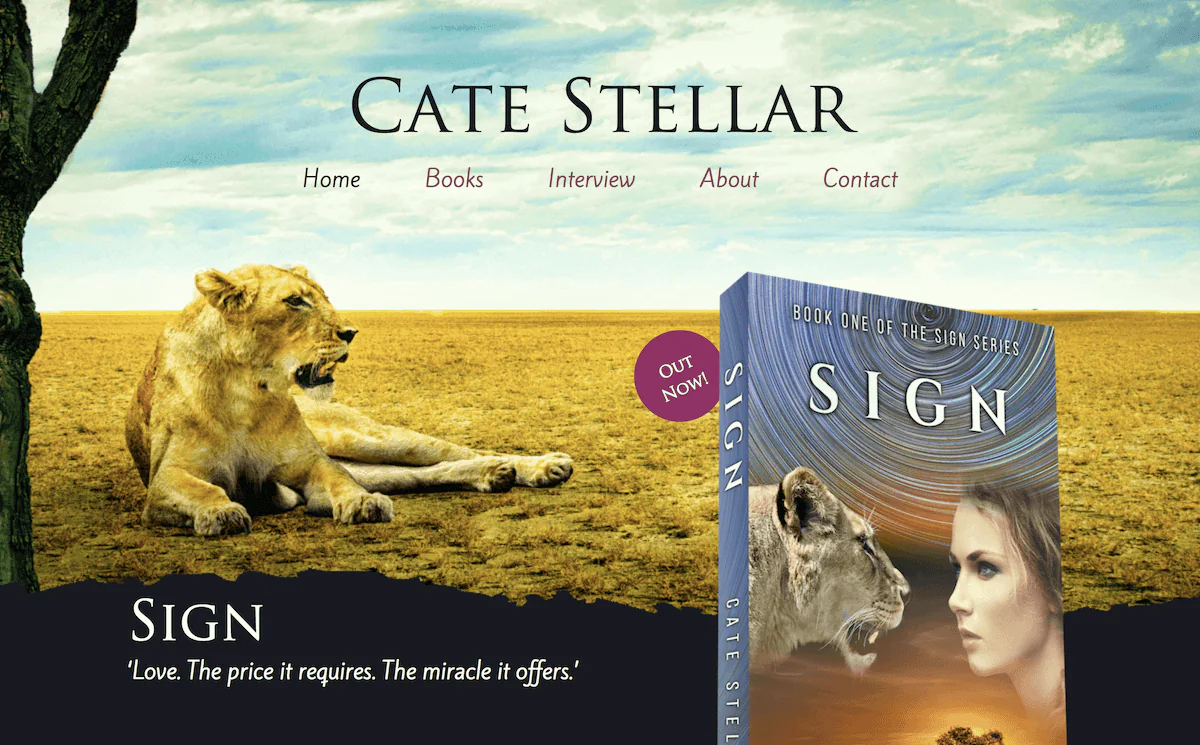
Cate Stellar, author of the Sign series, does this especially well. Her ‘about.’ and ‘interview’ pages make the connection between her novels, set on the African continent and post-Apartheid South Africa, and her personal life, having grown up in South Africa under apartheid. The landscape and atmosphere of that personal story is not only reflected in her novels, but also the visual design of the website:
Cate Stellar
3. Ideas for a romance author’s about page
Maya Rodale’s about page offers a great source of inspiration for what to include on your about page as a romance author (and any author in general!). Of course, it includes her bio, but also includes links to her other writing, press clippings and interviews, career highlights, and interesting images from both significant moments in her life as well as her everyday life. These elements combine to demonstrate what makes a great about page: it gives an accurate and sincere sense of the person behind the writing.
An effective romance author website tells your personal story while giving fans a glimpse into your writing world.
Maya Rodale


Paula Houseman
Paula’s site uses playful branding that reflects the humour in her novels. Her homepage emphasises her signature title Odyssey in a Teacup, with a clean two-tone palette and strong book descriptions. The inclusion of review snippets, personal background, and media interviews builds reader trust while showcasing her offbeat style.
Incorporating humour into both design and copy helps signal the reading experience your audience can expect. Let your website reflect your author voice, not just your book covers.
4. Include interviews about your romance novels and writing process
Related to the above ideas of telling your unique story, and having a great about page, is to dedicate a page on your website which includes videos and links to your live and transcribed interviews. Like your about or FAQ page, it’s a great way to offer readers a view into your perspective on the themes of your romance novels, and/or your writing process. See, for example, Julie James’s interviews page, which features multiple video interviews, including one about her novel Love, Irresistibly and another about writing contemporary romance:
Julie James

While Jenevieve Chang doesn’t write romance, her book The Good Girl of Chinatown debuted as a memoir, a market, like genre fiction, which entails analogous challenges of standing out amongst the crowd. Her website tackles these challenges by offering companion material offering her personal perspectives to complement the unique personal story of her memoir. Her about page includes a video interview on ABC. Jenevieve also runs a blog, where she elaborates on her thoughts on race and culture: themes also addressed in her memoir.
5. Offer samples of your romance writing
Given its saturated market, romance, and genre fiction in general, may involve a steeper curve than most when it comes to getting readers invested in a particular author. Also, veteran readers of genre fiction intuitively know the signs and conventions to look out for in their genre of choice when determining whether to spend time with a particular novel. That’s why it may be a good idea to offer samples of your writing on your website, like short stories, or chapter previews. These do more than a blurb to give the reader an idea of your ideas and writing style. Plus, the web medium means readers don’t have to stand around awkwardly in a book shop reading your first chapter!

6. Offer previews of your Audiobooks
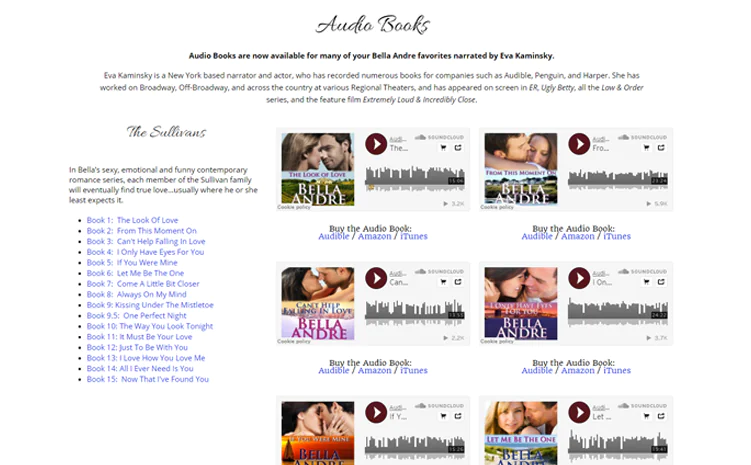
If your romance novels have Audiobook counterparts, think about offering short previews on audio platforms like SoundCloud and linking these on your website. Like writing samples, these offer a great way for readers to get an idea of your writing if they prefer consuming novels via audio. For example, see Bella Andre’s Audiobook page:
Bella Andre
7. Giveaways of your Romance novels
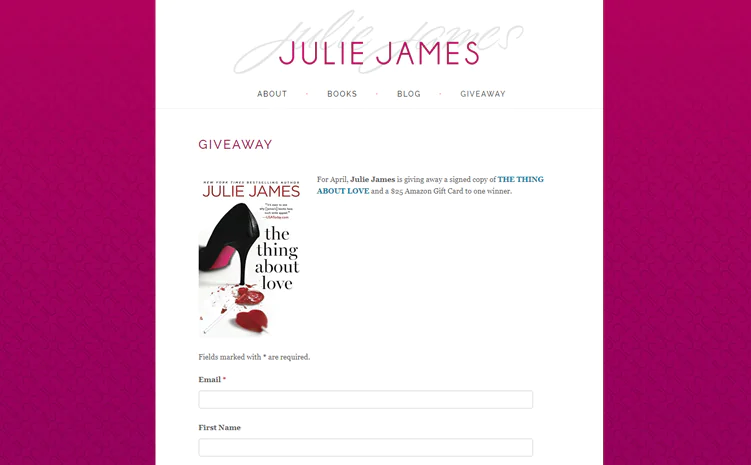
Did you know that Julie James gives away prizes to lucky readers each month? Giveaways create engagement with readers and fans and incentivize them to return to your website every now and again, where they’ll see new blog posts, the latest news, and your recent releases.
8. Blogging about your romance novels
A blog related to your romance writing is a great idea to keep your audiences invested, either in the world/s you’ve created in your novels, or in your ideas or style as an author.

L.T. Zee
L.T. Zee’s site reflects the author’s unique niche blending romantic comedy and self-help themes. The homepage leverages bright colours, casual fonts, and clear navigation into her main title Ditch the Dating Apps. The playful design tone aligns well with her audience while still keeping purchase links front and centre.
Match your tone and website voice to your specific sub-genre. For lighter romance or romantic comedy, fun playful branding signals genre fit immediately.
9. Run a newsletter about your romance writing
Your romance author website should always include a clear way for readers to join your mailing list.
A periodic newsletter is great for keeping in touch with readers and fans that offers something a little more personal than a public social media profile. It also provides a strong personal incentive to produce content for your website on a periodic basis to update readers about, whether it be news or blog posts.
If you run a newsletter, let the reader know on your website with an unobtrusive call to action to subscribe to it. In the call to action, make sure to let the subscriber know what they’re getting into: for example, the content of your newsletter, the benefits of subscribing, and/or the frequency of newsletter updates.
There are many ways to go about this:


Hannah McTavish
Hannah’s author website provides a strong model for new romance authors with smaller catalogues. Her simple layout is clean, mobile-friendly, and focuses heavily on newsletter signup and book samples. While minimal, it allows plenty of room to scale up as her catalogue grows.
For early-career authors, simplicity works. A well-designed one-page site with strong calls to action (newsletter + sample chapters) builds your email list early and supports organic growth.
10. Categorising your romance books and series
If you’re writing a romance series and releasing frequently, it may be a good idea to add a ‘coming soon’ page, to make sure your readers are up to date with your releases. For example, see Maya Rodale’s coming soon page for her new novel Duchess by Design:
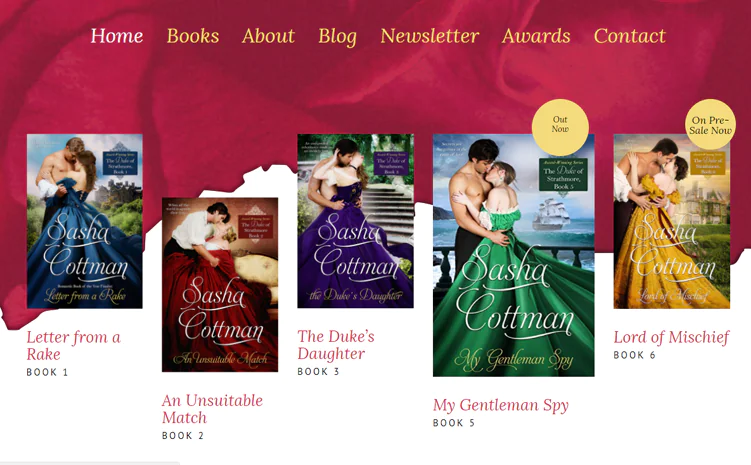
A more general, related, tip, is to think about how you organise the information on your website to best suit your series and its release times. For example, Sasha Cottman’s home page showcases five novels of her series: the first three books, a new release, and one coming soon. Maya Rodale does a similar thing on her books index page, categorising them by ‘new, next and classic’.

11. A book stack design for readers to browse your website
While we’re on the topic of categorising your books and series, what about a design, modelled after a bookstack, which creates a layout that easily and naturally categorises your books?

Jodi McAlister
Jodi’s romance author site uses a bold, confident visual approach — high-contrast pinks, reds, and blacks match both her academic voice and her high-heat romance writing. Book pages feature clear categorisation, reading orders, and an effective navigation menu that keeps readers engaged with both series and standalone titles. She also includes personal blog entries and media appearances that add authority. Don’t be afraid to lean into bold colour choices that reflect your subgenre and energy. Distinct visual branding helps your romance website stand out in search results and reader memory.
Want a design like this? Take a look at our other designs available to buy
12. Family Tree for Historical Romance Series
If you write in the sub-genre of historical romance, especially as part of a series, then a family tree is a great supplementary resource to offer readers on your website, to help them keep track of the oftentimes complex relationships and connections that can develop over a multi-book series. This can be in the form of an infographic image, like Bella Andre’s family tree for her series The Sullivans. Or it can be interactive, like Stephanie Laurens’ family tree for her Cynster novels.
Bella Andre

Stephanie Lauren

13. Printable download list of all books
One particularly helpful feature on you could easily use is a downloadable printable list of all books. This allows readers to easily track which titles they’ve read, what’s next, and keeps collectors engaged — especially valuable for series readers or gift buyers. Printable lists like this can also encourage email signups if offered as a simple opt-in incentive.

Jessica Gregory
Jessica Gregory’s site leans into modern simplicity: a hero banner with her latest cover, clear navigation, and fast access to her books and series. Her “Upcoming” section lets readers know what’s coming next, while her personal bio and Q&A sections help build loyalty with returning visitors.
Keep navigation frictionless. Make it obvious where your books are, what’s coming soon, and where readers can learn about you personally. Simple site structure often converts best. Tools like printable book lists add extra reader value while supporting long-term series engagement.
Summary
With these ideas, your romance author website can serve as both a marketing tool and a home for your readers.
- Keep your target readers in mind when starting to think about your website’s visual design
- Use your website to tell your unique personal story to invest readers in your romantic fiction
- Write an about page that creates an accurate impression of the writer behind the words
- Offer links to your live and transcribed interviews to offer readers insight into your processes and perspective
- Offer samples of your writing in the form of short stories or chapter previews
- Offer previews of your Audiobooks on your website
- Run giveaways to keep readers engaged with your website
- Run a blog that ties into the themes of your romantic fiction, or your interests as a romance writer
- Ask readers to subscribe to your newsletter, so they can keep up to date
- If you’re writing a series or multiple series, categorise your books in a way so readers can keep track. Think about a design that best accommodates that categorisation
- If you’re writing historical romance, a family tree works great on the web
For a broader look at what makes great author websites work, see my 50 Best Author Websites article for even more inspiration. For more genre-specific marketing insights, check out Romance Writers of America.
Our Experience Designing Romance Author Websites
At Jin & Co., we’ve had the privilege of designing professional author websites for romance writers across a wide range of sub-genres — from historical romance to romantic comedy, and everything in between. Our goal is always to create a site that reflects each author’s unique voice and connects authentically with their target readers.
By working closely with romance authors, we’ve seen firsthand which design patterns help readers find books, join mailing lists, and stay engaged over multiple series releases. We’ve drawn on those insights throughout this guide — and continue to update as best practices evolve.
If you’re planning your own romance author website, feel free to explore our available romance author website templates.